Quem se casou com Caroline Augusta van Beieren?
Wilhelm I of Württemberg se casou com Caroline Augusta van Beieren em . Caroline Augusta of Bavaria tinha 16 anos no dia do casamento (16 anos, 4 meses e 0 dias). Wilhelm I of Württemberg tinha 26 anos no dia do casamento (26 anos, 8 meses e 12 dias). A diferença de idade foi de 10 anos, 4 meses e 12 dias.
O casamento durou 7 anos, 7 meses e 4 dias (2774 dias). O casamento terminou em .
Francis II, Holy Roman Emperor se casou com Caroline Augusta van Beieren em . Carolina Augusta da Baviera tinha 24 anos no dia do casamento (24 anos, 9 meses e 2 dias). Francis II, Holy Roman Emperor tinha 48 anos no dia do casamento (48 anos, 8 meses e 29 dias). A diferença de idade foi de 23 anos, 11 meses e 27 dias.
O casamento durou 18 anos, 3 meses e 20 dias (6686 dias). O casamento terminou em .
Caroline Augusta van Beieren: Cronograma do Status do Casamento
1 Pixel = 1 Month

Caroline Augusta van Beieren
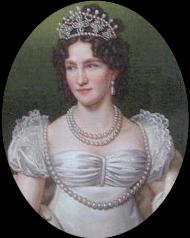
Carolina Charlotte Augusta van Beieren (Mannheim, 8 februari 1792 — Wenen, 9 februari 1873) was het vierde kind uit het eerste huwelijk van de Beierse koning Maximiliaan I met Augusta Wilhelmina van Hessen-Darmstadt. Haar oudere broer was de latere koning Lodewijk I.
Toen Charlotte Auguste vier jaar oud was, overleed haar moeder. Vrij kort daarna hertrouwde haar vader met Caroline, markgravin van Baden. Zij kreeg een goede, nadrukkelijk katholieke opvoeding. Om te ontkomen aan een verbinding met het huis Bonaparte verbond de zestienjarige prinses zich op 8 juni 1808 met de elf jaar oudere kroonprins van Württemberg, Willem. De prinses behield haar katholieke geloof. Het huwelijk bleek een volslagen mislukking. In de acht jaar dat het duurde was de echtgenoot vaak afwezig, op reis (vaak naar Kassel, waar hij een relatie had met een mooie hofdame van zijn zuster Catharina) of in een oorlog. Charlotte woonde intussen in Stuttgart, waar ze gewaardeerd werd door haar schoonouders. In 1814 verzocht het paar om ontbinding van het huwelijk vanwege wederkerige weerzin en omdat het niet geconsummeerd zou zijn. Een door koning Frederik benoemd huwelijksgerecht verklaarde het huwelijk ondanks verzet op 23 augustus 1814 ongeldig. Het argument dat het huwelijk om politieke redenen was gesloten en dus zonder instemming van de betrokkenen, werd door koning Frederik nadrukkelijk van de hand gewezen. De aansluitende procedure bij de Sacra Rota legde de schuld enkel neer bij de kroonprins, die een intiem samenzijn met het door hem als onaantrekkelijk beschouwde meisje had vermeden en vanaf het begin een schijnhuwelijk had gevoerd om persoonlijk vrij te zijn. Willem I van Württemberg hertrouwde met Catharina Paulowna van Rusland en werd bij haar de vader van Sophie van Württemberg. Op aanwijzing van koning Frederik kreeg Charlotte tot een nieuw huwelijk een jaarpensioen van 40.000 gulden.
Op 18 oktober 1816 trouwde de prinses de twee keer zo oude Oostenrijkse keizer Frans I/II, die reeds drie keer weduwnaar was geworden. Als teken van een nieuw begin voerde de prinses voortaan de Duitse naam Caroline. Zij was een goede stiefmoeder voor de kinderen uit de eerdere huwelijken van de keizer en ze vergrootte door haar huismoederlijk optreden de populariteit van het Weense hof. Het harmonische huwelijk bleef kinderloos. Keizerin Caroline zette zich in voor tal van liefdadigheidsprojecten en bleef, ook na de dood van haar man in 1835, als keizerin-weduwe een representante van het keizerlijk huis. Ze kreeg de bijnaam "moeder van de armen".
Leia mais...
Wilhelm I of Württemberg

Guilherme I (Frederico Guilherme Carlos; em alemão Friedrich Wilhelm Karl; Lubin, 27 de setembro de 1781 – Estugarda, 25 de junho de 1864) foi o Rei de Württemberg de 1816 até sua morte. Era o filho mais velho do rei Frederico I e sua primeira esposa Augusta de Brunsvique-Volfembutel.
O Reino de Württemberg estava sofrendo de péssimas colheitas e fome no Ano sem Verão logo quando Guilherme ascendeu ao trono. Ele imediatamente começou grandes reformas, resultando na aprovação da constituição em 25 de setembro de 1819. O reino se transformou de um país agricultural em um estado constitucional com um governo bem organizado e com uma identidade comum durante seus 48 anos de reinado.
Além do sucesso de suas políticas internas, Guilherme tinha ambições que se estendiam para a política germânica e europeia. Junto com as grandes potências da Prússia e Áustria, ele imaginava uma terceira grande potência germânica na forma da Baviera, Saxônia, Hanôver e Württemberg. Apesar do plano nunca ter sido alcançado, ele deu um único objetivo consistente e coerente para a política internacional do reino.
Leia mais...Caroline Augusta van Beieren
Francis II, Holy Roman Emperor

Francis II and I (German: Franz II; 12 February 1768 – 2 March 1835) was the last Holy Roman Emperor as Francis II from 1792 to 1806, and the first Emperor of Austria as Francis I from 1804 to 1835. He was also King of Germany, Hungary, Croatia and Bohemia, and served as the first president of the German Confederation following its establishment in 1815.
The eldest son of future Emperor Leopold II and Maria Luisa of Spain, Francis was born in Florence, where his father ruled as Grand Duke of Tuscany. Leopold became Holy Roman Emperor in 1790 but died two years later, and Francis succeeded him. His empire immediately became embroiled in the French Revolutionary Wars, the first of which ended in Austrian defeat and the loss of the left bank of the Rhine to France. After another French victory in the War of the Second Coalition, Napoleon crowned himself Emperor of the French. In response, Francis assumed the title of Emperor of Austria. He continued his leading role as Napoleon's adversary in the Napoleonic Wars, and suffered successive defeats that greatly weakened Austria as a European power. In 1806, after Napoleon created the Confederation of the Rhine, Francis abdicated as Holy Roman Emperor, which in effect marked the dissolution of the Holy Roman Empire. Following the defeat of the Fifth Coalition, Francis ceded more territory to France and was forced to wed his daughter Marie Louise to Napoleon.
In 1813, Francis turned against Napoleon and finally defeated him in the War of the Sixth Coalition, forcing the French emperor to abdicate. Austria took part as a leading member of the Holy Alliance at the Congress of Vienna, which was largely dominated by Francis's chancellor Klemens von Metternich, culminating in a new European order and the restoration of most of Francis's ancient dominions. Due to the establishment of the Concert of Europe, which resisted popular nationalist and liberal tendencies, Francis was viewed as a reactionary later in his reign. Francis died in 1835 at the age of 67 and was succeeded by his son, Ferdinand I.
Leia mais...